How we cut peak database write latency during LiteLLM upgrades by 99%
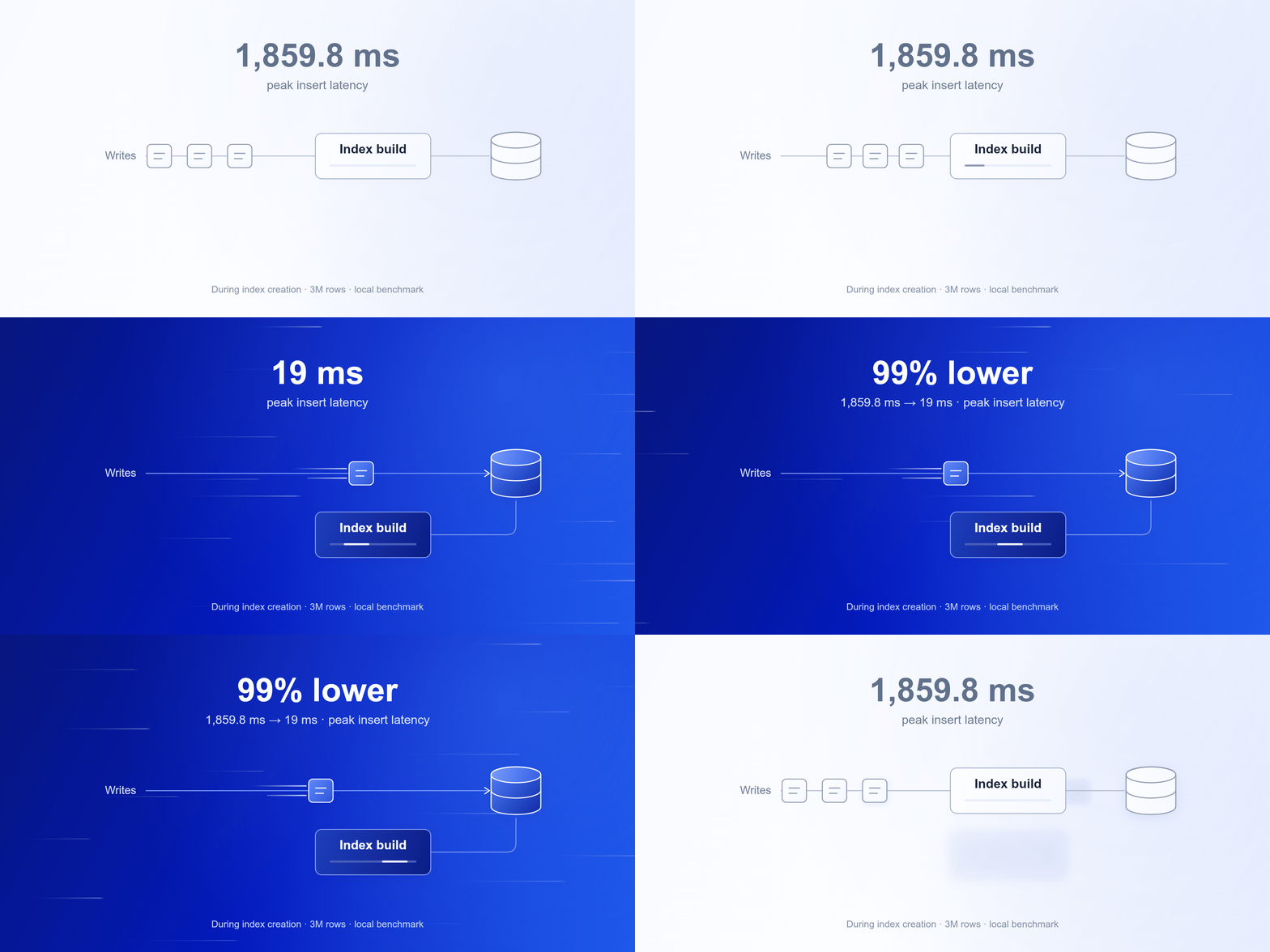

Adding an index should make your database faster. During LiteLLM upgrades, ours was blocking spend-log writes.
This week, we changed how those indexes are built. In a local upgrade benchmark with 3 million spend-log rows, the slowest observed insert dropped from 1,859.8 ms to 19 ms: a 99% reduction.
Why an index was blocking writes
An upgrade migration ran CREATE INDEX on the spend-log table. PostgreSQL blocked new writes while it built the index. With millions of rows, that meant new spend logs had to wait.
Switching to CREATE INDEX CONCURRENTLY alone did not solve it for partitioned databases. PostgreSQL does not support that statement on a partitioned parent, so the migration failed and could keep upgraded pods from starting.
Build indexes while writes continue
We moved these index builds out of schema migrations and into a dedicated builder. It uses CREATE INDEX CONCURRENTLY for ordinary tables. For partitioned tables, it builds each partition's index concurrently, then attaches it to the parent index. Valid existing indexes are reused.
We also fixed a remaining stall on partitioned databases. Creating the parent index and attaching a partition index still need locks. A long-running transaction could leave the index operation waiting, with spend-log writes queued behind it.
Both steps now use a 200 ms lock timeout and back off between retries. If the lock stays busy, the builder leaves the remaining work for the next build. In a separate PostgreSQL 16 test with a 10-second blocker, the slowest insert during partition attachment fell from 9.946 seconds to 197 ms.
How we measured the 99% reduction
The original benchmark used PostgreSQL 14.24 and the same 3-million-row, unpartitioned spend-log table before and after, with an insert attempted every 50 ms during the upgrade. The updated run completed 382 inserts with zero errors. A sampler checking every 100 ms observed no spend-log inserts waiting on a database lock.
The 1,859.8 ms and 19 ms figures are the slowest observed inserts during index creation in those runs.
See the changes: concurrent index builds and bounded lock waits for partitioned databases.